Welcome to Ulster Worldly, a blog about the history of Presbyterianism. Many of these stories come from my own family, many others come from my own denomination.
My great grandfather Hershey Longenecker and his wife Minnie served as Southern Presbyterian missionaries to the Belgian Congo from 1917 to 1951. In retirement, he wrote a memoir of his life and ministry entitled Memories of Congo. Some time ago, my dad’s cousin digitized the book, and he gave me permission to host it at congo.ulsterworldly.com.
Beginning in 1707 and for virtually every year throughout the century, the minutes of the Presbyterian Church contain petitions from congregations and presbyteries pleading for ministers. At least every other year, the Synods of Philadelphia and New York wrote to presbyteries in Scotland or Ireland, begging for ministers to come to the New World. By 1740 there were 160 congregations; in 1761 the synod lamented: “The Church suffers greatly for want of a Opportunity to instruct Students in the Knowledge of Divinity.”
Between 1716 and 1766, some 200,000 Scotch-Irish immigrated, primarily from Ulster, with the majority settling in the Shenandoah Valley. The meeting of the first post-Revolutionary Presbyterian General Assembly, in 1789, counted 215 congregations with ministers and 204 without. Recognizing the shortage of ministers, the assembly called for each synod to recommend two members as missionaries to the frontier.
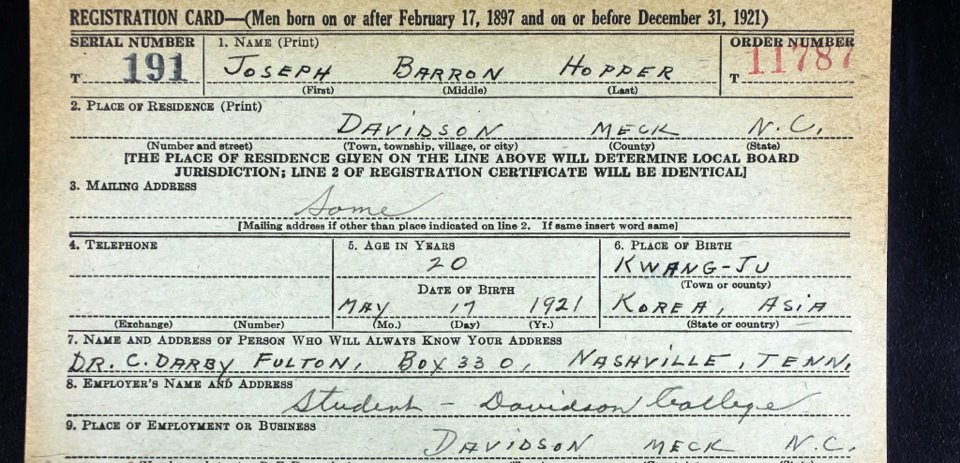
My grandfather was born in May 17, 1921 in Kwangju, Korea; he was the perfect age to have served in the Second Wold War, but the draft board gave him an exception because he’d been taken under care of the Concord Presbytery of the PCUS in fall 1939; he was told to continue his studies at Davidson College.
Here is his draft registration card from 1941:
Notably his “person who will always know your address” was Dr. C. Darby Fulton, Executive Secretary of Foreign Missions of the PCUS. Fulton, a missionary kid himself, had served as a missionary to Japan and preached at my grandfather’s baptism service on June 26, 1921. We would serve as the Executive Secretary from 1932 to 1961.
Yesterday, I sat down with my dear friend and former pastor Irfon Hughes to discuss his life and minstry. Pastor Hughes was born in 1942 in Wales and served as a minister for 50 years in 6 congregations in Wales, England, and the United States. Most recently, he was pastor of my church Shiloh Presbyterian Church (OPC) in Raleigh, NC.
The interview is split up into two parts, roughly consisting of his ministry in the United Kingdom in the first part and in the United States in the second part. I hope you enjoy hearing about how the Lord used this man for so many years. Press ️the ▶ buttons below to listen.
You can also download mp3 files for part 1 and part 2.
Transcript: Part 1
Irfon Hughes: My name is Irfon Hughes. I was born in Wales. But I’ve lived outside of Wales for well over 50 years, but I still speak my native language, the language of my parents, and my home, and my church. And I am privileged to be able to do so after such a length of time outside of the country.
Tim Hopper: Pastor Hughes, you recently, just at the end of the last year, stepped down from the session here at Shiloh Orthodox Presbyterian Church in Raleigh, North Carolina, where you served for four and a half years, I believe.
Irfon Hughes: Virtually five, yeah.
Tim Hopper: Almost five years. You were my pastor previously from 2004 to 2008 at Hillcrest Presbyterian Church in America in Western Pennsylvania.
So I thought, as we start to talk about your life, a good look at the way your ministry worked out and the way the Lord used you was during some of that time in Western Pennsylvania.
You served the church’s College Fellowship Ministry. Can you tell us a little bit about that ministry and what shape it took?
Irfon Hughes: I came to Hillcrest Presbyterian Church in 1992, and I served there until 2008. During that time, the church was very small and we had very little impact outside of our own congregation.
But I had a daughter who was in Grove City College, and consequently I had two sons who went to Grove City College as well. And so I made some contacts through my daughter specifically.
And when I became the minister at Hillcrest, she made a point of coming out to worship. The church was 10 miles away, and she had to get a ride, and we didn’t live in Grove City then. She would have to get a ride and brought some friends with her.
And then, about three or four years into my ministry, I started going to the college to have lunch with students that Catrin had brought out to the church. She by then had graduated, and Owen was there, but Owen had no great interest in talking to his father at that time, bringing his friends. He was into basketball, although basketball wasn’t into him, as they say.
And gradually the students that we accrued started asking was it possible to come and meet in our house for conversation. And lots of students would be entertained for lunch, and they wanted to come back, and they showed interest in just being in a home atmosphere.
And in about… I don’t remember precisely, but let’s say about 1998, I decided, with my wife’s consent, to start a fellowship on a Sunday evening for college students.
And again, it was very small to begin with. I think the maximum ultimately we had was about a hundred students, and if the local fire marshal had known, he would have shut us down immediately. The only blessing we had was that all windows were at ground level and people could leap out if there was a fire.
Tim Hopper: Right into the snow.
Irfon Hughes: Yeah, and so we decided to read. I was at a loss, really, how to interest and maintain an interest in and keep the attention of these students. And so I started reading to them and commenting to them on Puritan paperbacks that the Banner of Truth prints and publishes.
I can’t remember which one we started with. I was very enthusiastic about The Sovereignty of God by A.W. Pink, but it didn’t go really well. They weren’t terribly interested in that.
But then I picked up on Precious Remedies Against Satan’s Devices and that really… that really took off. The numbers increased. The students from other churches, from other backgrounds, started coming. We had Roman Catholics coming in.
And then I would speak in the house. They started at eight, so by the time we’d finished, it would be quarter past nine. And then after that, my wife would put out food, and of course students have no problems in eating food. And the food used to vanish.
The students then vanished, but some stayed on and talked and talked and wanted to know more and more. And it was a great opportunity. And my enthusiasm for the Puritans, which had begun way back—and I’ll say something about that in a moment—that enthusiasm seemed to be contagious. And they just loved to hear.
We had people, visiting preachers in our church, would come. Joel Beeke was there on one occasion, and he remains enthusiastic and impressed by the gathering there. And I remember Dr. Joe Pipa from Greenville. We had these college presidents, it was quite humbling, and they thought it was a great idea.
Tim Hopper: I remember Dr. Pipa said to you afterwards—he came for our winter conference in 2005; it was a very formative conference for me—that if we went to the General Assembly and said, “This British minister in his mid-60s is standing in his living room reading from the Puritans, and eighty college students are showing up,” no one would believe you.
Irfon Hughes: Joe and I are good friends, and we’ve been friends for 40, 50 years probably. I first met him at a Banner of Truth conference in the United Kingdom way back, I think it was about 1975, ‘76, something like that.
He and a fellow called David Jussely, who taught at RTS in Jackson, Mississippi, they came to visit somebody who came to the Banner conference, and they came as well.
And I’d been going to the Banner conference since about 1968. I was converted when I was about 15, and I was greatly influenced by the minister that I had at that time, a man called H.H. Williams.
Just a little anecdote: his name was Harry Harry Williams. Apparently, traditionally in North Wales, you give your first son the father’s name. Well, they gave him his first name, Harry, and his father’s name was Harry, so he was Harry Harry. And he was known as H.H.
And he had become, in about 1945, ‘46, a passionate evangelist. Something had happened in his life, and I don’t quite recall what it was, and he started preaching salvation according to the tradition of our Calvinistic Methodist denomination.
And he had a salutary effect on the church of which he was the minister at that time, Bethel, Cross Hands in Carmarthenshire. My father was from Cross Hands, but he never went to church as a boy.
Tim Hopper: Can we step back and talk about your earlier life, prior to when you were converted at 15?
Yeah, we’re coming to that.
Anyway, H.H. was called to our church. I was born in 1942, which makes me at this point 76.
I was brought up in a religious home, not a Christian Home per se. My parents went to church on occasion.
My grandmother seems to have been a Christian but, from a lack of teaching… she was born in 1880. Liberalism was creeping into the denomination, and she was influenced by the Revival of 1904-1905. She was widowed in 1911 with three children.
My grandfather seems to have been a Christian as well. But her demeanor and her desire that we would go to church with some regularity played a part in my life.
My brother contracted polio when he was two years of age, and my father always wanted a farm, and so we went to a farm. My mother knew nothing about farming but picked it up bit by bit.
And we lived in a very remote part of Wales, in central Wales, and we went to church in a place called Bethesda. We would go there occasionally. My parents were members, but it was occasional that we went there.
Tim Hopper: Was it a Welsh Calvinistic Methodist?
Irfon Hughes: Welsh Calvinistic Methodist, but Presbyterian. We went, paid very little attention. I was more interested in looking at the ceiling than I was at listening to the minister, and the minister probably was a liberal anyway, but that’s beside the point.
In 1952 or 1951, my grandmother died. And we lived in a very remote place, so my mother wanted to go back to where she was born and brought up, where there were relatives. And we bought a farm, and we went there.
And then we went to Bethel Presbyterian Church in Hirwaun, where my parents had been members—before, my mother particularly. And we went there. It’s amazing, really. My mother was not a Christian, my father was certainly not a Christian, and yet they’d been accepted as members in good standing. That tells you something about the state of the Presbyterian Church at that time.
And it was to that church that H.H. Williams came to be the minister, and that was about 1956. And I trace my conversion to 1957, when I came under a conviction of sin, which I didn’t understand, and I don’t think he did either, although he was an Evangelical.
And at that point, I felt that I should be a minister. Why me, particularly? I think my mother said—I heard her saying, “I wish everyone would become a minister”—but that’s scarcely a call to the ministry. But I felt an inward compulsion that I should be a minister.
And so I went to H.H. He knew I’d been converted, and I said, “I think I want to go in the ministry.” And so he set in motion at that point all the Presbyterian book of church order with regard to my being examined by the candidates’ board, which happened in Carmarthen in West Wales.
I remember going down with my father and my uncle—they took me down—and being examined about my Christian testimony, which was pathetic, I am sure. And I was there with two other men older than myself; I was 16. And one was a graduate of Oxford University. And one had played rugby for Wales, so… and he was 6'4". I’m talking to Tim here who is, I believe, 6'10", but he tells me 6'9".
Tim Hopper: My mom says 6 foot 10. That’s where you learn.
Irfon Hughes: His mom and I are on the same page. And he was a big man, Elwin Jones I think his name was, and he played rugby for Wales.
And when he stood before the committee and said he played rugby for Wales, there were no questions asked. Nobody argued.
Playing rugby in Wales is like a religion.
And the other fellow, Richard—I can’t remember his last name—but he was a very clever fellow.
And we were all accepted as students for the ministry.
Tim Hopper: This was while you were still a teenager?
Irfon Hughes: Sixteen.
Tim Hopper: Okay, so you’d just recently converted and effectively coming under…
Irfon Hughes: And that meant I was allowed to preach. And so on June 8, 1958, I preached my first sermon in Bethel, Hirwaun and in Jerusalem, Penderyn, which was a joint charge. It was from the text in Mark 10, “The stone that the builders rejected has become the head of the corner.”
I wrote a sermon. It was probably pathetic because H.H. took it, revised it, supplemented it, added to it, corrected it. And that was my first sermon. It wasn’t my sermon per se, but it was my text. That’s what I wanted to preach on.
And that’s been my text, I suppose, all along: that Christ Jesus, who was rejected by wicked men, was made the head of the church. And so that’s how my pilgrimage began.
I won prizes in school. And the first prize I won, I was told, “Pick a book.” And I went to H.H. and I said, “What book shall I pick?” And he said, “There’s this new publishing house started,” he said, “called The Banner of Truth. And they’ve got a reprint of a man called David Dickson. I know nothing about him,” he said, “but he’s got a commentary on the Psalms.”
I said, “I’ll get that.” So I told the school registrar, or whatever they were called in those days, and they got me this book for my prize. And it was a valued possession. My son who is in the ministry, Owen, he’s got that.
I was looking for it the other day and I thought, “What’s happened to my book on the Psalms, David Dickson?” And Owen… I said to Owen, “My library belongs to you.” He said, “I don’t want it. I don’t want your library.” He said, “I get all your books on my telephone. I just pick them out and they come up.”
But he said, “I’ll take some books that are precious to you.” So I said, “Well, you take your pick,” and he picked the Psalms.
But anyway, that was my first Banner book. And then because I was conscious of The Banner, whenever I got the opportunity to buy a Banner book—and there were not many in Wales—I didn’t go to Cardiff, the capital, to the bookshop there. I couldn’t do that. I couldn’t travel there; I didn’t have a car. I could have gone on the bus, but it would take hours, and I didn’t know it was there anyway.
But I saw on occasions… And then I can remember going… by now I was in university, I think. Yes, I was, in my first year. And there were some special preaching services over in a neighboring valley. And a fellow called Malcolm Evans was preaching there, and they had a bookstore.
And there was a book there, published by The Banner, called The Sovereignty of God by A.W. Pink. It revolutionized my life. It changed me from being a Christian to being a real Christian.
Now I understood sovereignty, what it meant: that God was in charge. And that remains a theme to me in my praying, in my speaking: the sovereignty of God. God rules everything.
And that book just changed my life. I still have that copy. I didn’t let Owen take that; it’s in my desk. And every so often I take it out and I see where I’ve underlined it. Just changed me.
I had a Bible, and I would put by the verses PD or SV. PD was predestination, SV was sovereignty. You go through the Bible and there every verse has got a line alongside it, a song to God.
And so that was my introduction to the Banner of Truth.
Well, when I was at University prior to that, in 1958, I went to an Evangelical Movement of Wales camp. And then met a whole slew of young people, many of whom were Christians. Some came to faith at the camp. And the following year, ‘58, my brother came and he was converted there.
But be that as it may, I met there people who really loved God and taught me what it meant to preach the gospel. And then all this was sealed by understanding things like divine sovereignty, the authority of the Bible, Bible truth.
And all those things are ingrained in me. I’m not an academic. I’m not a very clever fellow, and I say that not to elicit your sympathy—that’s just not so.
Tim Hopper: You didn’t hear that from me.
Irfon Hughes: No. Tim has been a very good corrective for any boasting people might make of me. I’m just a very ordinary Christian. And but these things just stir my soul when I read the scriptures—and I read the scriptures obviously every day.
When I read—I was reading just yesterday a prayer of Nehemiah. Oh, God is before his eyes. The majesty of God is before his eyes, the sovereignty of God is before his eyes, the power of God. God is wonderful. And I just… and these things just possessed me, as it were.
Well then, I met with Pentecostals, Pentecostals in the United Kingdom, the forerunners of the charismatic movement, but they’re a denomination of their own. And became desirous to have the baptism of the spirit without any teaching. I didn’t understand that I was baptized with the spirit. And I went through all those growing pains of being a Christian and developing as a Christian.
Well then, I’ve already been there before in my conversation: I went to University, studied Welsh and history, and Hebrew in my first year, and that proved to be very useful. I can still read my Hebrew Bible—I don’t always understand what I’m reading, but I can read my Hebrew Bible—and then my Greek New Testament.
But it was always a desire to preach Jesus Christ, that God’s remedy for sin.
Well, I went into the ministry. I went to a little Baptist church. During this time, I was expelled from my seminary along with three other men.
Tim Hopper: Can you fill in some details of how you got from University to the seminary, and then how you were expelled?
Irfon Hughes: Yeah. Well, let’s… I was in university. There I met many fine Christians, some of whom are quite well known now in America and in the United Kingdom for that matter. And one of them was a fellow called Jeff Thomas. He was a minister in Aberystwyth where my seminary was, but let’s back up a bit.
I was in university, and during that time I contracted diabetes. And I had been 220 pounds, and I lost 90 pounds, and obviously I was weak.
Mentally, physically… it was a great trial to my parents more than it was for me, really. It affected me, and so my stamina had gone, and studying was laborious to me.
And I passed half my exams, which they credited to me, but the other half I failed, and I had to re-sit those at a later date.
Well, the natural course of events was in the Presbyterian Church of Wales, you went to university—if you went to university at all—and then automatically you were accepted into their seminary or theological college in the town of Aberystwyth, where my friend, ultimately, Jeff Thomas, finished up as a minister.
Tim Hopper: Is that the sole seminary of the denomination?
Irfon Hughes: It was the sole graduating seminary. There were two minor preparatory schools, in Bala in North Wales and Trefeca in the southwest, but those were for men who didn’t go to university. And they just did higher college school courses and then were accepted. But it was a formal, purely automatic thing, and I was at seminary.
A theological college. And whilst there, I met men, and some of them had very radical views on the state of the Presbyterian Church of Wales, amongst whom was a man called Richard Holst.
Richard Holst and I became firm friends. We shared a study together. His… always a pile of books. He worked like a beaver. He was industrious.
He had been to university and got his degree in Hebrew and biblical studies, and he knew what he was doing, and I was sitting there like a potato. And but we shared the study, and we got on quite well.
And it’s been a very pleasant for me now, at the end of my life, to sit under the ministry of his son. Both of us here in Shiloh Presbyterian Church, and I love him very much. I love him as a son. He’s my friend’s son, and I’m more privileged than his father because I can sit under his ministry.
Tim Hopper: And his brother Jonathan is also a minister in our denomination.
Irfon Hughes: That’s right, that’s right. And then his brother Ben is a surgeon in Cardiff in Wales, in the Heath, University Hospital… or he’s an anesthesiologist—sorry, not a surgeon, an anesthesiologist.
Tim Hopper: So you and Richard are at the seminary of the Welsh Presbyterian Church.
Irfon Hughes: That’s right. There was an English wing, and Richard is English, English-speaking. And his wife, who he met when he was in seminary, she was at the University College of Wales, Aberystwyth, and she was there.
Whilst I was there, I was able to complete my degree, but by that time it was too late to go on to a graduate theological degree.
And then because we were expelled for asking the church to return to its confession of faith, and to be more evangelical and careful in its accepting students for the ministry, we were politely asked to leave. We were expelled, basically.
Tim Hopper: Did the denomination use the Westminster standards?
Irfon Hughes: They had a confession of faith which was based on the Westminster, but it was a Welsh Confession of Faith, and that being drawn up in 1811 by the fathers of the denomination. And it’s based on the Westminster, but there were some other parts to it.
A person couldn’t be accepted if they were shipwreckers, for example—that they went along the coast and dangled candles and suggested to ships that they would find a port, and they were only rocks, and then they would… you couldn’t be a member of the church if you did that.
But the Presbyterian Church of Wales has a… when it was a Calvinistic Methodist Church, which it changed in 1933 when it became the PCW. But it had a rich history of sound biblical preaching—men like John Elias, Howell Harris, Daniel Rowland.
This had been a powerful church, and great revivals of religion which affected the whole of Wales would happen. One of the most famous was in 1859, and that was probably the last orthodox revival under the ministry of a man called David Morgan.
He preached the length and breadth of Wales, and whenever he went to preach, crowds would come and people were affected. It was reckoned that public houses—which are bars—they were devastated because of the conversion of people. And men read their Bibles at the coal face when they were working underground. The effect was electric.
But then liberalism came in. And some of the great giants of the church—Thomas Charles Edwards and others—they’d been to Germany to study, and they’d been affected by the higher criticism. They came back and they wanted to be more reasonable in their faith.
In 1904, there was a revival, but that was very much a Pentecostal revival. Evan Roberts led that, and it was very emotional. He wouldn’t preach unless he was led, and all that subjectivism that came in with that.
Some men have defended it, amongst them Dr. Martyn Lloyd-Jones, but I don’t agree with the doctor on that issue. But that’s another story.
And so those are the kind of things that had affected our denomination.
Tim Hopper: So some modernism was already present in the 50s when you were converted.
Irfon Hughes: Every teacher at the theological college was affected by it. The only man that had some remnant of evangelical truths in his teaching and in his preaching was a man called Williams. His father had been converted, I think, in the 1904 Revival. He went back to what it once had been, our denomination, its character.
But he taught Philosophy, and he was the one who was most sympathetic. I can remember talking to him one day; we were walking along the prom, which is by the ocean.
He was telling me, “I understand your stand,” he said. “I know, I agree with you. The denomination is not doing well, and it’s just departed from these truths.”
And [unclear: portal was going blind], and I said to him as we’re walking along, “[unclear: Tilis?] is coming down”—he was a celebrity in Wales. And he said, “Well, when we get close to him, tell me that we’re close and then I can talk to him.”
So I said, “Ten yards away.” He ran out—Dr. Williams—just ten yards away, and he said, “Hello, [unclear: Ti?]!” and then they had a talk.
Anyway. That was at the college, at the seminary where we were, and he taught his philosophy of religion there.
But generally, the denomination had declined, and by now the church at the seminary has closed. Students go elsewhere, and very few come into the ministry.
The denomination is virtually obliterated. It’s tragic. It’s a tragic story.
Tim Hopper: And there wasn’t particularly any kind of continuing denomination?
Irfon Hughes: Such talk… even evangelicals, when we protested about this liberalism, even evangelicals said we were wrong. And if you should stay and transform the denomination from inside—it can’t be done. My experience is it can’t be done.
And when I hear men saying to me now in the PCUSA—you meet them occasionally—and they say, “Well, we’re working from the inside,” forget it. Politics will always beat spirituality.
Until God, of course, changes the whole dynamic, but it’s not God’s will at this time. Anyway, I’ve grown up through that.
Hate… I think that’s a stronger word than I would use, but I hate internal politics in denominations, and you see it in all of them. But that’s a whole other story.
That’s part of my experience: I don’t trust denominational politics because that ultimately will destroy the denomination.
If the OPC—and I don’t know the Orthodox Presbyterian Church terribly well, I’m a transplant from the Presbyterian Church in America—and there was internal politics there. It’s still there now.
And I could see dreaded tentacles spreading into every part of the denomination: women, ordaining women for the office of Deacon—they haven’t done it yet, but they’re just waiting for the chance to do it. Always an attempt to undermine scriptural principles, and many people are weak.
And evangelicals say they don’t want to destroy the denomination because [unclear: a thread of strong truths are still strong reformed men in the]… John Piper, whom we mentioned a moment ago, is very much in the forefront of that.
Still, denominational politics will ultimately, unless God changes it, win the day. And the same with the Orthodox Presbyterian Church, a bit slower because they’re more conscious of their history.
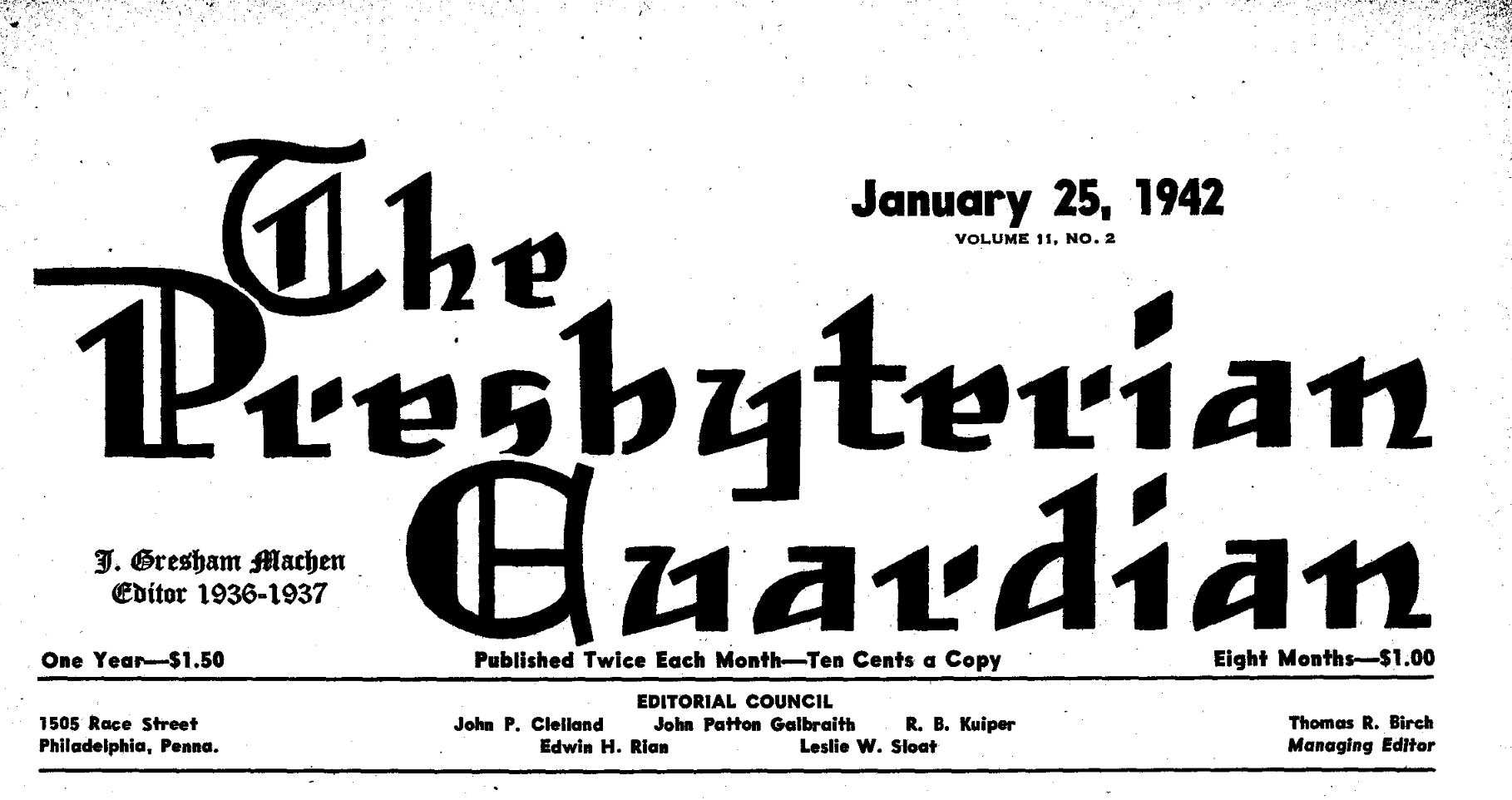
And the cost of founding the denomination for J. Gresham Machen and men like that. But sadly, if politics gets a hand, danger ensues.
Anyway.
Tim Hopper: I want to come back to this point where you and Richard Holst and the others were asked to leave seminary. But at what point in this did you meet Ann?
Irfon Hughes: Now, that is a great story. I’d met Ann before I went to seminary. We’d been at a party. Now, in Wales, young people would get together, and it was called a party.
Her sister and her sister’s best friend, Beryl Penny, organized this party in Beryl’s home. I was there, and I had taken another young lady with me. But that’s another story.
And Ann was working in the kitchen. She had insisted to her sister that she be allowed to go, and her sister had said, “You’re too young, you can’t go.” Her sister, by the way, sadly—not tragically, but sadly—died just a year ago from cancer, Christobel.
Be that as it may, she said, “No, you can’t come.” And Ann and her best friend, Val, said, “We want to work in the… we’ll work in the kitchen if we can come.” And they said, “Okay.”
In those days, no paper plates, nothing like that, so dishes had to be washed. And Ann and Val washed those things and then came into the general merriment.
And I saw this gorgeous girl with long black hair and wearing a blue sweater and a yellow skirt. And my heart was gone. And I found out her address.
In those days, you didn’t have telephones in homes. Her parents didn’t have a telephone, and my parents… no, they didn’t have a telephone. We didn’t have a telephone.
But I found her address, and when I got back to college, I wrote to her and asked her if she’d come out with me. And she said yes, she would.
And she came down to Cardiff on the train—I was in Cardiff then—and we had a wonderful afternoon and evening together. And then I took her home. The rest is history. It wasn’t without its initial bumps, but that was it.
Tim Hopper: So were you married when you were in seminary?
I finished seminary in 1967. Well, I was thrown out by then, and by then I had decided I was a Baptist, and I had accepted a call to a church in a neighboring valley to where Ann was from.
She’s from the Merthyr Valley; I’m from the neighboring valley going west, the Aberdare Valley. And I took a church in the Rhymney Valley, which was the neighboring valley to the Merthyr Valley.
By which time we had been in contact and dating for three years. And we got married on 22nd of July 1967, and then we moved into the manse, the church manse.
And that’s a story, but I’m not going to tell it.
Tim Hopper: A story that’s only tangential, but I just learned about from you fairly recently, was Ann’s family was from near where the Aberfan disaster happened. Can you tell that briefly, just because I think it’s an interesting part of Welsh history?
Irfon Hughes: In 1966, there was a great tragedy in Wales. Coal was extracted from underground and washed—strange to say that about something that was black, but they washed it—and there was always waste called small coal. And for a century and a half, the small coal had been tipped on the side of the mountains, and they were enormous mounds, massive mounds of coal.
Many of them you still see them; they’re covered with grass now. But these massive tips… well, there had been some heavy rain, and nobody had realized that under this huge amount of millions of tons of coal dust, there was a stream.
And the rain had come and undermined this thing, and it skidded, slipped down into a valley and killed… engulfed a school. And 147 children and teachers were suffocated and died there. It was a national tragedy.
A national tragedy. It occupied the TV stations for two or three weeks as searches were made to find bodies and to find any survivors, and there were none. It was an enormous event, and it happened in the Merthyr Valley, called Merthyr Vale. It inundated the village and Aberfan. It inundated Aberfan school and a part of the housing there.
I came down from Aberystwyth. I was preaching not far away from there, and I came down to Ann’s home. They wouldn’t let me into the valley—police stopped me. And in the end, I was able to convince a policeman that I was only going two streets into the town, and he let me in, and the whole place was electrified by this terrible tragedy that had happened.
Everything stopped. Everybody sat with bated breath to see if they could rescue anybody. It was a major, major disaster. I know nothing like it, I think, ever since. Maybe the Twin Towers was similar, and that, of course, captivated the whole nation.
Well, the whole nation was captivated by the Aberfan disaster. And that happened in 1966, and Ann and I were going to get married in 1967. I was down, she was home from college, and we were trapped there, really.
But that was fine. I was able to get around and in and out, and I can’t remember if I got out and went home because I didn’t live far away, or I stayed overnight in Ann’s home. I can’t remember. But that was a major event.
And I can remember preaching the Sunday after. And of course, you’d have to advert in your sermon to the disaster and try to make application of the suddenness of death and the need for repentance. And I can remember people being visibly moved by what I preached that Sunday. It was an interesting time.
Tim Hopper: 1966—speaking of that year, was that the year that you were called to this Baptist church that you led?
Irfon Hughes: Yeah, ‘66, ‘67, that happened. It was late spring because then I knew I was going to be expelled from the seminary, and I accepted this call.
Tim Hopper: Did you decide you were a Baptist because they weren’t modernists, or because—
Irfon Hughes: Basically, there were more evangelicals in the Baptist denomination. There was more emphasis on conversion, because they wouldn’t baptize you with immersion if there was no conversion. And I didn’t understand the Covenant; I didn’t understand it one bit.
My ignorance is to be blamed on myself and not to anyone else. It was… I was just ignorant.
And my best friend at that time was a fellow called Jeff Thomas, who was a minister in Aberystwyth. And we’d become close friends. He and his wife, whom I’d met in 1957, Iola, they gave me a home while I was finishing my degree at Aberystwyth University, and his influence on me was significant.
But at that time, I met Professor John Murray as well, so I just… And that was interesting. Professor Murray was very influential on one level.
I asked him one night—we was at a meeting, and he’d been preaching for Jeff at Alfred Place, Aberystwyth—and I asked Professor Murray, “How can I be reformed?”
And he said to me… He had only one eye, and people used to say—students used to say—it was the one that twinkled, but that’s when he looked at me, and I don’t know if it was a good eye or the bad eye. And he said, “Read Warfield. Now I’m going to my bed.” And that was it.
Tim Hopper: This is when he had retired back to Scotland?
Irfon Hughes: Yeah, he… yeah, I think he’d retired. And of course, he’d got married for the first and the only time. And I don’t know if Logan had been born then; that’s his eldest son. His, yeah, his only son. They had a little girl later called Annemarie, and she died the same year as her father. Father died in 1968, if my memory serves me correctly. So, yeah, I met Professor Murray.
Tim Hopper: You also had interactions with Dr. Lloyd-Jones through this time.
Irfon Hughes: Yes. I had. Dr. Lloyd-Jones had been a friend of a great-uncle of mine who was a minister, and when I heard him the first time in the Heath Church in Cardiff, I made myself known to him and told him who I was.
Tim Hopper: That’s in college?
Irfon Hughes: I was in university then, and I met him then. He was just an electrifying preacher, just amazing. Very quiet, very non-fuss. There were certain elements of enthusiasm as a sermon got going, but basically he would start with his familiar nasal tone: “Very well then… my text this morning, or this afternoon, is from Acts chapter 15…” and then he would go on like that.
And then he would just grip you, and the whole congregation was gripped with him as he preached.
He was a latter-day Puritan evangelist, because he was very Welsh, and he was very enthusiastic about the commencement and the revivals that begat the Calvinistic Methodist Church.
He became ultimately a Baptist, I believe, but his sacramental position was never clear. And people said, “Oh yes, he is a Baptist,” and others, “No, no, he’s a Congregationalist.”
So…
Tim Hopper: Had he retired from Westminster Chapel by this time? He didn’t retire in 1968, and this was in 1962 or ‘63. And he was, but he would still tour a couple of days a week, Monday, Tuesday, Wednesday, Thursday. He would go out to preach and then go home and prepare for the Lord’s Day. And it was fascinating.
But the two-volume biography by Iain Murray, there’s not much to beat that for the life of Lloyd-Jones. And nothing, in fact. There are critics of Lloyd-Jones and they write little books about him, but basically his… He lacked a clear ecclesiology, but that’s not—this is neither the time nor the place to talk about that anyway.
I met him then, and then I invited him to preach at the first church I was, I believe, a Baptist in Rhymney. And he came there, and the little building, it was seated about 800. And a typical Welsh church. Maybe you’ve got 100 in the congregation, you did fine.
The decline was in, but the place was packed to heaven. I couldn’t get out of the pulpit. I had introduced the service and read the scriptures and give out the hymns, and I couldn’t—there was no way for me to sit. I had to sit in the pulpit behind him.
And I remember him preaching, and he… they opened windows, and they really had to work hard. The windows had been painted in and somebody had to go and get a knife and cut around the painting in order to open the upper.
And I remember vividly—and you can say what you like, I remember it—the place was humid. Can imagine 800-plus people in this building on a March evening. And it hadn’t been a cold day.
I’d picked him up from the train station in Cardiff and brought him home, and we had lots of traffic. And I was afraid he wouldn’t get home to have something to eat, and he came in and said to my mom, “Don’t worry about it, it’ll be fine.”
And he… my aunt had made a little… things called pikelets and Welsh cakes. And he just loved them. He put lashings of butter and gallons of preserves on them and just ate them and loved it.
And anyway, Dr. Lloyd-Jones up there in the pulpit and he was preaching, and it was going very badly. He just couldn’t get going, as it were—and preachers know what I mean. And suddenly there was a breeze from one of these open windows. Suddenly he was alive. Just held us in the palm of his hand for the best part of an hour. It was just marvelous.
But there were lots of incidents involved with that, and which I’m not going to go into, but it was a great time. And then his son-in-law, I think… or maybe his… no, or his… His brother-in-law. Yes, E.J. Phillips was in the congregation and took him home to Cardiff, so I didn’t get his company then.
And then I’d asked—in order to get him to come to preach, you had to pay with a price of blood. And I’d asked him, I’d written to him and asked him if he would come to preach. And he said to me he couldn’t make any plans because he was very busy.
Well, soon afterwards he came to preach in a neighboring town where my wife was from and the church where my wife was brought up. Well, where she’d gone to when she was, at the compulsion of her sister who was a Christian. And Park Baptist.
And I went there to hear the Doctor, and the minister—Ann and I’d got married there in 1967—so when I came, the minister, Iorwerth Budge, said to me, “Come and start the service, Irfon.” So I said, “Okay.”
And I met the Doctor and we were sitting in the pulpit, and Iorwerth Budge introduced the speaker and gave out the first hymn, and then I read the scriptures. And then Iorwerth got up and gave out the second hymn, and I prayed. And I was granted great liberty in praying.
And afterwards, I sat down and the Doctor reached across to me and said, “When did you want me to come to preach?” And I said, “Oh, March.” So he said he would come. Yeah. So that was it.
And we were never friends, obviously. He was an infinitely greater man than I was—just a little pastor—but he always knew me and always was willing to talk to me. And I was very humbled by that. It was very nice.
Tim Hopper: Have you seen this Logic on Fire documentary?
Irfon Hughes: Yes, yes. And the men in it, most of whom I know. The Americans I don’t know, but I don’t know if the Americans understand him. But that’s not something to expound on.
Tim Hopper: I have a couple more questions about your ministry and life in Wales before we move on to your call to Sheffield. One thing we’ve just alluded to is that you grew up as a Welsh speaker. Is that what was predominantly spoken in your home?
Irfon Hughes: Yes. My parents always spoke English to each other for some reason. They met in England in 1938, and they always spoke English to each other, but they always spoke Welsh to my brother and I. My Welsh developed better than my brother’s.
My brother’s Welsh… he still speaks Welsh and he still understands Welsh. He’s never been as fluent as I am.
Anyway, he… we both spoke Welsh, and my parents, and then my grandmother when she was alive, she spoke Welsh to us. And we went to a Welsh-speaking church and read the Bible in Welsh in the church and understood the scriptures in Welsh.
And when we did do anything with English, it was the Authorized Version, the King James Version, which from which I can still quote. But I can’t quote from the ESV. Nothing is memorable in those. The Authorized Version is amazing; it’s an amazing translation. Every verse—it may not be accurate—but every verse has a word that you can hang on to and… And I still use it from time to time.
In fact, I was just thinking this morning that I need to look at some verses in the Psalms to memorize more of the verses in the Psalms, but I will use the Authorized Version for that. It’ll stick in my mind.
And then our culture… there was lots of Welsh in the culture, but it was an anglicized area. South Wales became anglicized quite early on. With mining and people coming in to work from Somerset and Cornwall and Gloucestershire, and so it became a very anglicized area.
Eastern Wales, Monmouthshire, where my first church was, that’s more anglicized than Glamorganshire at that time. But by now that’s crept west, and you’ve got to go as far as Carmarthenshire to hear Welsh spoken on the streets more, but less and less of that.
And further west, Pembrokeshire is very English—is called “Little England beyond Wales.” And Cardiganshire has more Welsh, or there was more Welsh.
And then North Wales, it was predominantly Welsh-speaking, but… and may still be, but I haven’t been in North Wales for 50 years and I couldn’t tell you. But they speak Welsh with a more nasal accent—they talk like that, and they speak Welsh like that, and their Welsh is like that. But I had some good friends who were North Walians and not so good friends who were North Walians.
Tim Hopper: Well, I think a related question that I would be remiss not to ask is how you ended up with a name like Irfon.
Irfon Hughes: Irfon is a Welsh name. My father’s best friend in school was called Irfon, and so when I was born I was given my grandfather’s name, Richard; my father’s best friend’s name, Irfon; my mother’s patronymic, Parry; and then my father’s name, Hughes. So I’m R.I.P. Hughes.
When I was baptized, the minister who baptized me, Dai Davis—who was probably an old-school Evangelical but had been influenced by the liberalism that come in, he was a man of a sense of humor—and when he baptized me, he added the name David.
So I became David Richard Irfon Parry… D.R.I.P..
So I say this, and I know that others are going to hear it, but I’m telling you, that was my baptismal name. But I’ve never used David because it’s not my official name.
But R.I.P. is bad enough, and… so that’s…
Tim Hopper: Thankfully you didn’t end up with Irvine Irfon Hughes.
Irfon Hughes: Yeah, but I couldn’t do that because my father was Ieuan, and I could, of course, have been Ieuan Hughes. But I was never Evan Morgan at all, and that’s a blessing. But I’m quite proud of my Welsh name.
Tim Hopper: You don’t begrudge your parents for seventy-six years of mispronunciation from…?
Irfon Hughes: No, no, no. I can live with it. I can live with it. They loved me, and I can live with it.
They didn’t name me like that… well, they never expected me to live outside Wales and they fully expected me to marry a Welsh-speaking wife.
They thought that I would be some kind of ordinary person, and they never expected me to be a minister.
It’s only as I grew older, I certainly had the gift of the gab and I could talk a lot.
Someone said once I’d been vaccinated with a gramophone needle. But that would be lost on most people, because they would not know what a gramophone needle was.
Tim Hopper: One other topic I wanted to come back to before we take a break was, in university you studied history, which I know has been a love for you ever since. Was it something you had enjoyed even prior to that point?
Irfon Hughes: I’ve always liked history. The love of history was imbued in me by a teacher called Mrs. Webbley. Anyway, she said to me… good at remembering dates. And that was it, and history became a passion. I love history. I buy history books. I love history. I’ve grown to love other things too, but history is a delight. And Welsh as a language is a delight as well.
Transcript: Part 2
Tim Hopper: In 1967 you were called to this Baptist Church. Did you serve there until you were called to the north of England?
Irfon Hughes: No. I was at this church until 1971, and I resigned. The church, to my disappointment, was not even Evangelical and certainly not Evangelical in its mode of operation. And they really made things difficult.
One deacon—because they don’t have elders—one deacon, an old man whose father had been the minister there back in the 30s, Harold… Harold once spat on me because I insisted people need to be born again, and he just was so angry. He didn’t hear much. He had a hearing aid, and when he wanted to hear something, he’d hold his hearing aid up, [unclear], and when he didn’t bother, he would put it in his pocket.
I would give out the announcements and he’d be listening, and then he’d put it in his pocket and he wouldn’t listen after that. And I had that for a period of time. Another man likewise.
There was a woman in the church who was a member, and she never came. And she had a very lurid moral history. And I said, “Well, she gave the most money.” The list appeared every year, how much money, and she gave the most—not much by modern-day standards, but it was the most. And I said that this woman ought to be excommunicated, both for her moral background and for her lack of attendance.
And that really set the cat among the pigeons, if I was going to exclude people who gave so much money—and it was 20 pounds, it was nothing, it wasn’t even 10 shillings a week. If I would exclude that, who else could I exclude? And this went on; it was a battle. And in the end, I realized that it was a losing battle.
And because of my diabetes, that affects my health if I’m in a struggle, I decided that I would resign. And of course, they were very sorry I was resigning, and it reflected badly on them. In the village, people would say things about them, and so they were willing to have me, but I had to stay on their terms. And I said no, and that was it.
And so I resigned, and I was out of the ministry for… About… I went back in in 1973, and I resigned at the end of ‘71, so about 18 months I was out of the ministry. And then I received this call to an independent Calvinistic church in Sheffield in the north of England, Wickliffe Chapel, now known as Wickliffe Church, and flourishing.
I was followed by a man called John [Waite?] who was a professor at the [unclear] Bible College. And they were closing their college, and they called John, and John went there and ministered well.
And he was followed by a man called… Oh, his name escapes me. I remember meeting him, and he came from Wales, and he was a lawyer by training, because Evangelical seminaries are very rare in the United Kingdom. There’s one, the London Theological Seminary, LTS, but I don’t know of any others.
And this fellow, who was a lawyer from Wales and had been called to the ministry and had exercised the ministry in Wales, he came, and he was pretty incisive. And there was one man in that church… He made life very difficult.
And I stayed there for 12 years, and they were—nine of the hardest years of my life. They were hard years; he was a difficult man.
I wrote to him recently, I emailed him recently. Because of him, I came to America. I received a call to a church in America, and I wouldn’t have come. I wouldn’t have ventured, I wouldn’t have thought of it. But I couldn’t stay where I was and was convinced that it would kill me. My health was in a steep decline.
So I accepted this call to the ministry. So I wrote to him; I sent him an email. I got his address from his son and I sent him an email, and I’ve never heard back from him. But I thanked him for having persuaded me that I needed to find fresh pastures.
He stayed in the church and tried to run things, but this lawyer guy, he was fit to deal with him—clever enough and quick-minded enough, and I wasn’t. And I liked him, I had liked him, but he made life very difficult.
Tim Hopper: So your ministry: you are converted as a teenager and quickly have this sense of call to the ministry, and then attend university, and then you attend a seminary that’s a challenging experience and a liberal seminary. And then you have this difficult ministry for several years in this Baptist church, and then you go to Sheffield and have a difficult ministry there. Did you consider leaving the ministry through those years?
Irfon Hughes: Yes, I did at one point. This man had five children. And one of the children, who was a teenager, 15, 16, 17 years of age… one Sunday after I’d preached, I was always the last to leave.
The treasurer, who was a deacon, George Taylor—who ultimately is responsible for me being a paedobaptist, an infant Baptist—George was an avid, ardent reformed man. And George and I were always the last to leave the church, and he drove me home or I drove him home, it depended which one of us had a car. And this young man was hanging around.
And I said, “So what’s going on?” and he was going through some really difficult spiritual battles. And I spent an hour with him, an hour and a half maybe. He was at home alone; his father and mother had gone away.
We had a deacons’ meeting—or the church officers’ meeting, the elders and deacons met together—the following evening. And after the meeting was over, his father, Derek, said, “Could I have a word with you privately?” I said, “Sure,” wondering what was going to fall on my head.
And he said, “You are never to talk to my children about spiritual issues ever again. None of them. You are not to touch them, not to talk to them, not to instruct them.”
Well, it just broke my heart. It just broke my heart. And I went home and told Anne.
And then two days later, two of the younger church members—one a medical student, and one was ultimately an elder… They—Mike Silas and, what’s his name… he’ll come back to me anyway. Steve Ward. And they came to see me.
I said to Steve—I’d played squash with Steve on the Tuesday morning—and I’d said I was very upset by what he had said to me. And so he and Mike Silas, who was the doctor—he was a doctor by then—came to see me and they said, “What’s happened?” They sat down and they were incensed. They were incensed. And they were prepared to bring charges against him in the church.
I said, “No, no. Let’s preserve the peace here. Let’s do that.”
Anyway, soon afterwards I became very ill. I had a medical condition, and I was sick. I was a real sick man. And for six weeks until I had surgery—I had surgery at the end of the year, but this was in the fall—the sun never rose, as far as I was concerned.
I’d walk every day and it was dark. When people talk about depression, I know exactly what they’re talking about. It was dark. It was dark. I remember it vividly.
And then I had my gallbladder removed, and things got better. But by this time, this had happened and all this… I knew I couldn’t carry on. This was more than I could handle, and so soon after, things were set in motion and I came to America. But that was a hard time.
But… well, no, I’m not going to talk about subsequent… I’d been to America in 1981. I’d been to Canada. I’d been to preach—I’d been invited to preach for a minister, a PCA minister, in Cape Breton, Nova Scotia.
And I came over and I spent three weeks, I think, preaching in New Brunswick, in… yeah, in New Brunswick, in… oh, I can’t remember the other province… and then in Nova Scotia. And had a very good time there and made some good friends.
One of the men that I stayed with, David Katherine, who has now gone to glory—he and his dear wife have gone to glory in the last three or four years—he had given my name to a church, a Congregational Church in Massachusetts, Emmanuel Chapel. And they contacted me and asked for tapes. I didn’t have CDs in those days; it had tapes.
So I sent them some tapes. And I must have sent the tapes on Monday. They were on the phone to me on Friday: “We’ve heard your tapes. You’re just the man we want.” “Will you come to be our minister?”
Well, I thrashed about for a couple of months. Do you take your family—five children, a wife, myself—and go to America? Sell up everything?
And it was so bad. I had an elder, a lovely fellow called Clive Pete, who was a doctor. And I saw Clive on a Friday. He was going on vacation on the Saturday, and he said, “Are you going to go?” And I said, “No, I’m not going to go. I can’t risk it. I can’t go. I wanted to get rid of Derek, I want to get away from Derek, but… I wasn’t going to go.”
And then by the Saturday, I changed my mind. It was… it was by the hour. I’d tell somebody at breakfast I’m not going, and by lunchtime I was going. It was so difficult.
And then on the Saturday, I talked to my friend Jeff Thomas, who is a minister in Aberystwyth, where Clive and Janet were going on vacation. On the Sunday morning, they were walking out of the church and they talked to Jeff at the door. And Jeff said, “So, Irfon is going to America then?” And Clive said, “No, he’s not. He told me he wasn’t going.”
Anyway, I decided to come to America, and I came to America in 1983.
Tim Hopper: So when you went to Sheffield, did that church baptize infants?
Irfon Hughes: It baptized both, by-law. There, I became a paedobaptist. I told the elders that I had.
This man Derek—against whom I hold no malice—said, “Well, we have to consider whether you can stay as a minister.” And someone said, “Well, we have Baptists in the eldership as well.”
This man, Clive Pete, was a Baptist. And so the church was congregational.
It had taken the Savoy Declaration, and there’s a clause there that says children must be baptized. And it was changed from “must” to “may.” So you could baptize children, infants, and you could do credobaptism.
And I don’t think I ever did paedo, but maybe I did to some Chinese students who were converted, but they weren’t immersed; they were sprinkled.
And then I baptized… maybe I didn’t baptize… but certainly one of my children, Gareth, was baptized by a friend called John Le, who had a great influence on me. And he was preaching for us at a conference, the spring and fall conference. He was preaching there, and Gareth was born in April, and this was in May, and he baptized Gareth.
I don’t know who baptized Rowan, I can’t remember.
But anyway, Catrin was baptized by paedobaptism, but she was… she was a believer when she was ever so young, ever so young. So anyway…
Tim Hopper: So by the time you received this call to Massachusetts, you were a convinced paedobaptist, and that was a paedobaptist church?
Irfon Hughes: No, that was a congregational paedobaptist church.
Tim Hopper: Which is now an Orthodox Presbyterian Church. It’s now an Orthodox Presbyterian.
Irfon Hughes: That’s correct. It always should have been Presbyterian, and it always should have been OP, because that was its character. Sure.
And when I went into the PCA, I knew I couldn’t stay there because they would never go into the PCA because it was too loosey-goosey for them.
And they were strict and strong, and it was planted by a man called Norman Brower, who was himself a strong man.
But he never… he went into one of the Dutch denominations eventually, but he planted a couple of congregational churches, one of which has collapsed and one which continues, Emmanuel, to this day.
Tim Hopper: When you were in Sheffield in the ’70s, were you aware of the conservative Presbyterian American scene? The PCA was forming during that time. Was that on your radar?
Irfon Hughes: The PCA was formed in 1982, I think.
Tim Hopper: ’73.
Irfon Hughes: ’73, right. Well, I came to America in 1992, so… ’92. But yeah, right, sorry. I went to Hillcrest.
Yes, I was aware of it. The Banner of Truth magazine would publish something by David [Duncey?], who was OP or PCA.
And I got to know some men, and they were PCA. But I came to this country and I never expected to go into the PCA. I would have liked to. But I never expected it.
And when I got to know the PCA more, then I was more attracted to it.
But Emmanuel was never going to go into a Presbyterian Church. It was too… Norm was a committed congregationalist. Most of the people there had been converted into his ministry or come to the church under his ministry, and they were committed as well.
And it was never going to happen in my time. In my successor’s time, it didn’t happen. And then my further successor—two successors—it would never have happened with them.
But then the third man to follow me…
Tim Hopper: Mark… Mark Marquis…
Irfon Hughes: Mark Mair, he came and was congregational, and he brought it into the OPC. One of the elders, a young man who was the most gifted young man, [Jason Pet?], being convinced of Presbyterianism… and circumstances were such, anyway, they came into the OPC at that time.
Tim Hopper: So was your call there simply by them hearing your tapes, or did they actually have you come and candidate?
Irfon Hughes: Yeah, I came to candidate. I spent a week in Massachusetts.
Tim Hopper: With your whole family, or you?
Irfon Hughes: No, on my own. When I got home, my eyes were so bad. My blood sugars were so high—which I didn’t know about; I didn’t keep a close watch on them—that my eyes were affected and I couldn’t see with my glasses.
And when I got off the train, Ann came to meet me off the train. She didn’t know me. But my face had changed and everything. It’s just the effects of sugar.
Coming to America, you do eat a lot of carbs, and I really packed it on.
So I came and I candidated here, and they issued a call. Unanimous? No, not unanimous. I’ve never had a unanimous call. It was a call with a couple of dissensions, and I decided to accept the call and came, as I said, in 1984.
Tim Hopper: If I recall correctly, when you were married, Ann was quite homesick just moving a valley over. Was it a hard sell for her to go to Massachusetts?
Irfon Hughes: Well, it was. But she got over her homesickness in a record time. Her sister was with her; Crystal Bell stayed with us for a couple of weeks, and that helped her, and she got over it.
She got over it in about three months; it was done.
I, on the other hand, seemed to get over it in a week, and then it hit me, and for two years I was so homesick because I’d done so much in the United Kingdom.
There was the Ministers’ Reform Fellowship, or RMF, where I was the chairman, and I was involved with things of that order, and counseled ministers and traveled to meet with ministers to comfort them and encourage them.
And I really was very involved in the good of the church. I loved it.
And then I did the Chinese Fellowship. The Chinese were to come to our church and they had a…
Tim Hopper: That’s in Sheffield.
Irfon Hughes: And they would come to our church, and then they had a house. They belonged to the CCOM, Chinese Christian Overseas Mission, and they had bought a house and several of them lived there.
They would have a fellowship on a Saturday afternoon and I would go and speak at that, or I would go and keep an eye on who was speaking there. And I was their pastor, basically. [I got stuff in the house?], mentors of that time.
And I loved working with Chinese, and I still have the greatest admiration for the Chinese people.
As a young Christian, I wanted to be a missionary to China, and I really did. I’d read all the books, and that to me was my field.
My health broke down and that was never going to be possible.
And one of the Chinese said to me once, “You want to be a missionary to China, pastor, but God sent the Chinese to you.”
Irfon Hughes: And I was their pastor, and they looked to me. Not all of them attended with us, but many of them did. There was a whole squad of Chinese came to us. But even those who didn’t, they would call me and ask me to help them and to advise them and so on.
So I had all that going on, and then I had the Yorkshire Reform Ministers’ Fellowship, and I was chairman of that. I was voted into that job about the second year I was there, and I chaired it for 10 or 11 years and pastored the pastors and looked after them and got to know their situations and traveled around Yorkshire and preached. Every week I was preaching somewhere within the fellowship. A church in Huddersfield: “Could you come and preach for us on Friday night and Saturday?” And life was very full and difficult.
Even though the church life… the church life was good. We had to extend the building internally, and I did most of that by myself. And there was a platform behind the pulpit.
And this is just a funny story. There was a platform behind the pulpit. When the building was built in about 1880, they expected they would have a choir there. Well, of course, they never had a choir; the congregation was always too small. And then it was taken over by the people who formed Wycliffe. And they said, “Well, we’ve got to take out that platform and take the pulpit back.”
That’s what we did, except I did it on my own. I took this platform down. I was working underneath it, and there were nails yay long. And then to get them down, to take the plank… and the planks were the width of the building, pretty much. And the building was, I don’t know, 25, 30 feet. And these long planks, I took them all down, put them down in a waste hole down in the basement.
I came home after doing that one day. I couldn’t do it all because bits of it were too heavy to carry. I came home and Catrin was a baby, maybe one year, maybe two years old. And I came home and she didn’t know me. My face was black, ‘cause she cried and screamed because my face was so black.
Then we were able to take the pulpit back, and it took ten young, strong men to pick up the pulpit and to get it back. And I remember vividly, one man was at the back and we put it down and he’s standing there… “Don’t say anything, Dave.” I said, “What’s the matter?” “My foot.” The pulpit was the last… [unclear]. He was a surgeon. He died just a few months ago—cancer, 79 years of age. And he used to call me when I was here and we would talk, and we were good friends. He was a good friend.
So that was the time then. The church expanded and more people came, and it was a good time. On one level, it was an excellent time.
I tell the story, you may have heard it, of the young man who came and he had a crucifix. I was preaching about the cross and we shouldn’t wear crucifixes… covering up his crucifixion, but I don’t know if it was true. I don’t know. And of course, I’ve been gone from there 30-plus years now, 35 years. So I don’t know these people any longer.
But anyway, the call to Upton, and I came to Upton in ‘82… no, sorry, ‘84. ‘84. And then I spent nine and a half years there, and then I came to Hillcrest.
Tim Hopper: Before we come to Hillcrest, you said when you first came to Upton you just felt very disconnected after all those connections that you had in the UK. Did you find connections with other ministers? Make them. You got to do it yourself.
And so I got to know an Englishman who ministered 15, 20 miles away, called John Crighton, and we were talking one day and I said, “Wouldn’t it be great if we had a ministers’ fraternal in this area?” “That’s a good idea,” he said.
He contacted a man that he knew, and I contacted a couple of men that I had got to know, and contacted people in the denomination in the PCA and the OPC, and we got a fraternal going called the Southern New England, or the New England Reformed Fellowship—NERF. We were NERFs, and they used to call me Papa NERF. I was popping off.
And one day we were sitting around having lunch together—sandwiches and chatter—and I said, “Wouldn’t it be good to have a Minister’s conference?” “Yeah, well, maybe we should have a conference for our wives as well.”
Well, I was not for that. I was for a model of the Banner of Truth Ministers’ Conference in the United Kingdom: only men. But they wanted—because they were Americans—they wanted their wives to come, so that was it.
And it still exists. It’s called the Bolton Conference. And it meets now in Whitinsville. It left Bolton, where John Crighton was the minister, and came to Whitinsville, and they meet in Whitinsville every year.
And they had eminent speakers come over from the United Kingdom and here from the United States, and some… they have some good conferences. And it still goes, and that was founded… I spoke at the 20th conference, and I think I was still in Hillcrest, and I’ve been from Hillcrest ten years, so it must have been going 30 years at least.
And still… Rob Hill—do you ever know Rob?—Rob goes to it now, and he is a part of the Southern New England Reformed Fellowship, because it became Southern New England Reformed Fellowship because they formed another one in the north. And Rob goes to that from Western Massachusetts, West Springfield, and says that it goes very well. He’s been very impressed with the way it was put together.
So we did that. I got contacts.
Tim Hopper: Was the American Banner of Truth Pastors’ Conference going at that time?
Irfon Hughes: It was, and I went to the first one that I was here in the States for. That was in 1983, ‘84. It was over in Grand Rapids, and we drove over there. A man who’s now the principal of a Baptist seminary in Texas, Jim [Ranahan?], Jim came, and David [Katherine?], who was my friend out in Duanesburg, New York, we picked him up, and we drove over to Grand Rapids.
It took us a day and a half to do that. And a day and a half to come back. And Jim went some other way back, I think. I don’t remember him traveling with us.
But anyway, we went over together to that, and that was in Grand Rapids, in Calvin and Calvin Seminary. And I remember vividly, I had made a good friend called Al Martin when I was in the United Kingdom, and Al sees me coming in the door, and he’s a big man, he’s six feet tall—well, not that now, he’s a very sick, old man—but he was coming across, and he saw me and just raced across the Calvin Chapel and picked me up, and people thought that there’s something happened to him or I’d done something wrong. Just such an embrace.
And then, of course, the Banner was affected by the split between Al and Walt Chantry, and both of them now old and feeble men. I tried to engineer a reconciliation between them. There was no reconciling. That’s very sad.
Anyway, I went to the Banner and I identified with the Banner.
Tim Hopper: You attended that conference for many, many years, right?
Irfon Hughes: Oh, yes, yes, yes. And went to lots of places. It was held down in… When was the minister… he stayed in the RCA and he had a church down in… oh, some southern place, and I don’t remember where it was.
And went down there, and of course, going down in the spring and the blossoms were out and all that kind of thing. It’s lovely.
Yeah, I went to that a lot of times. And then it moved. They then split it up; there was an East Coast Conference and a West Coast Conference.
And so it split, and it changed its venue. It went to… it came to Pennsylvania. It was in Messiah College for a lot of time, and then it’s moved again now to Elizabethtown.
I’ve been there a couple of times. I don’t go now, mainly because of my health and because it’s a long way to drive up there. I went two years ago with Owen.
Tim Hopper: But that’s been an important conference for you, just in relationships outside of even just edification of the conference itself.
Irfon Hughes: Oh yeah, the conferences were good and I enjoyed them. In fact, I was responsible for organizing them for five years, from 2000 to 2005. Joel Beeke, a Baptist called Steve Martin who is now the provost of this Baptist seminary out in mid-Texas, and myself. And I was chairman of this little committee, and I organized it.
Its venues… it was always at Messiah in my time. Got to know the men then and the contact, of course. And because you moderate a conference, because you speak at it—because one of us spoke every year, of the committee… Steve Martin spoke one year, I spoke a couple of times, and Joel spoke a couple of times.
And then they decided to move the organization from America to the committee of the Banner, and they organized it. Ian Hamilton is often over here—he’s a trustee of Greenville Theological Seminary and he comes over often—and so they run it that way now.
And I went after they reorganized it, but I retired then in 2008 and I was not quite as involved. And I moved down here to South Carolina, and that’s a long drive to Pennsylvania. And they moved it to Elizabethtown, and that’s even more complicated to get to.
So, as I said, I’ve been a couple of times, but I don’t have the same urgency as it was. But the Banner has always been—since David Dickson on the Psalms—the Banner has been a constant in my thinking.
And I know Iain Murray, the founder. I knew Jack Cullum, who was the money behind the Banner. Impressive fellow, Jack. Six foot eight. Impressive, godly man.
He suffered terrible disappointments and sadness in his life, and then eventually he took his own life. I went to his funeral, and Paul Tucker preached it. I remember it was held in the Welsh Chapel in Chilton Street in London.
But he was a gracious man, was Jack. He gave me a gift once of money, 200 pounds, and that became the basis of our buying a house in America. It became part of our down payment… part of our down payment for the house in Sheffield, come to think of it, and then the house in America.
And then every place we had a home, we were able, and Jack Cullum’s money lay at the base of it. So the Banner has always been a major part of my life.
Tim Hopper: And a major part of your library as well. It was… I bought sets and I’ve been blessed in that I’ve been able to sell it to the church. I still think that I was a bit stung by what was offered.
Tim Hopper: I had nothing to do with the price.
Irfon Hughes: But it was… Yeah, the Banner. I thank God for the Banner. I thank God for Iain, and they’re both still alive, both well into their 80s. Still get a letter from him and Jean occasionally.
Tim Hopper: I remember after college, because you had introduced me to the Banner of Truth, I sent him a handwritten letter. Somehow, I guess I just mailed it to the Banner of Truth, and I got a letter back from him and he asked me for your email address. He was more tech-savvy than I would have guessed.
Irfon Hughes: Yeah, he was a sharp cookie, Iain Murray. He is a godly, gracious, kindly man, but as hard as nails. You don’t organize a book outfit like the Banner and be a softie.
He is a good man, like Walt Chantry is a good man, and Al Martin. I respect them all. They are to be admired and emulated in so many ways.
But my closest friend is Jeff Thomas, who cared for the Banner website for a number of years and retired after 52 years in church in Aberystwyth.
And his wife died 18 months ago, and he remarried. Last year he was 80 in October; he remarried in May. And his wife, Barbara, is a lovely lady. I’ve met her once; I don’t know her.
But I had a note from Jeff today, in fact, which ended with a Welsh greeting.
Anyway, I came to Hillcrest.
Tim Hopper: Tell that story. How did you end up getting from Massachusetts to Western Pennsylvania?
Irfon Hughes: Well, I had decided that congregationalism was not my cup of tea. I became covenantal in baptizing children. And then I got to understand the Westminster Confession; I studied the confession.
And I realized that I was a Presbyterian. In truth, not just nominally. I love the confession, I love the Shorter Catechism and the larger one, too. I love them.
And I realized that my sympathies and my temperament and my attitude was PCA and not OPC. I visited OPC things, but I always felt like a sore thumb. They didn’t embrace me. I was congregational…
And but if I go to a PCA church, a PCA organization or gathering, I was always welcome.
And then I met a man called Howard Griffith who teaches now at Washington, at the RTS in Washington. And Howard, he’s years younger than me. And Howard’s attitude was so catholic, the way that I felt about people, that I thought, “This is my home.”
And so I applied to a church in Western Pennsylvania called Hillcrest Presbyterian Church. And it had been called Church of the Living Word, but that was before my time.
Tim Hopper: Was Catrin already attending there at the time?
Irfon Hughes: Catrin was at Grove City College. She went to Hillcrest normally on a Sunday morning, and then she’d go to the OP on the Sunday evening. The OP church is only 100 yards away from the college—well, more than 100 but not more than 500—and she would go there in the evening, but in the morning she’d come out to Hillcrest, and so they knew her a little bit.
And then I came. I candidated there in March.
Oh, it was cold. There had been a blizzard, and the blizzard had come right across, and it was in Massachusetts. I drove down to Rhode Island to catch a plane from Providence to fly down to Pittsburgh, and we had to follow a snow plow in order to get to the airport.
Anyway, I left a call there, and then Anne flew home before me, and I stayed and candidated there—preached twice on the Sunday, taught Sunday school.
They called me. They had a congregational meeting on Wednesday after I’d been there, and everybody but four people voted for me out of about 45, and so I had a majority of the vote.
There were four people, and I can’t remember who the four were, and two of them later made a point of telling me that they’d voted against me, but now they regretted having done so.
And those were the happiest years of my life. Oh.
Tim Hopper: You served there from ‘92 to…?
Irfon Hughes: ‘92 until… I was there for 15 years, so it must have been ‘93 to 2008.
Tim Hopper: ‘08, so when I graduated.
Irfon Hughes: Yeah. It was a great, great time. I preached. And I would have carried on preaching.
I would do sometimes as many as 500 visits a year. Loved the pastoral work, loved traveling.
We had members… if I visited my most northerly member and most southerly member on the same day, I did something like 70 miles.
The McCains were way up, and Ray Frasier and Peggy were way down. They were in Butler.
I rarely did that, but that’s the length of pastoral care I had.
Tim Hopper: Where did you learn to do pastoral visitation like that?
Irfon Hughes: From H.S. Williams. He was an inveterate visitor and dealt with problems with people. It wasn’t counseling, but if you had a complaint, you brought it up to him. And that’s where I learned it, right at the beginning, and I did it in all my churches. Less efficiently here in Shiloh because I’m older and I’m not able to get out and about as much as I did.
Tim Hopper: But it’s something that if you ask someone who knows about your ministry, that’s one of the things that will come up, is your commitment to visiting your…
Irfon Hughes: Yeah, I hope it would be, because that’s what I would do. And in the home. And I was a back-door visitor, not a front-door visitor. A back-door visitor.
I made a point of being where people were in the house. They’d say, “What are you doing here? This is the kitchen.” I’d say, “Well, what, do you live in the kitchen?”
And I really feel that I know that in a church like Shiloh, spread around, I know that that’s hard. But we’re not called to an easy life.
And you need to see people in their home environment. How do they deal with their children? How do they deal with their wives or their husbands? How do they deal with the issues that come?
I know it’s difficult, but it can be done. You say, “Well, women can’t be visitors on their own by a man.” That’s true. Got to be very careful.
Some women you can; they’re mature enough and they’re stable enough, and if you know there’s an issue there, you just pop in and see them. You don’t have to spend an hour there or two hours; you don’t have to lock a door.
Ann would come with me on some of these visits. If there was somebody that we knew would be alone, she would come with me. But I visited older people, older women, on their own.
Tim Hopper: I came to Hillcrest in 2004. After my family had only been in a Presbyterian Church for two years, I wasn’t necessarily a committed Presbyterian at that point.
And it’s a church out in the country—literally out in the cornfields—that was formed by these Scots-Irish farmers who were there as their previous church had become more liberal.
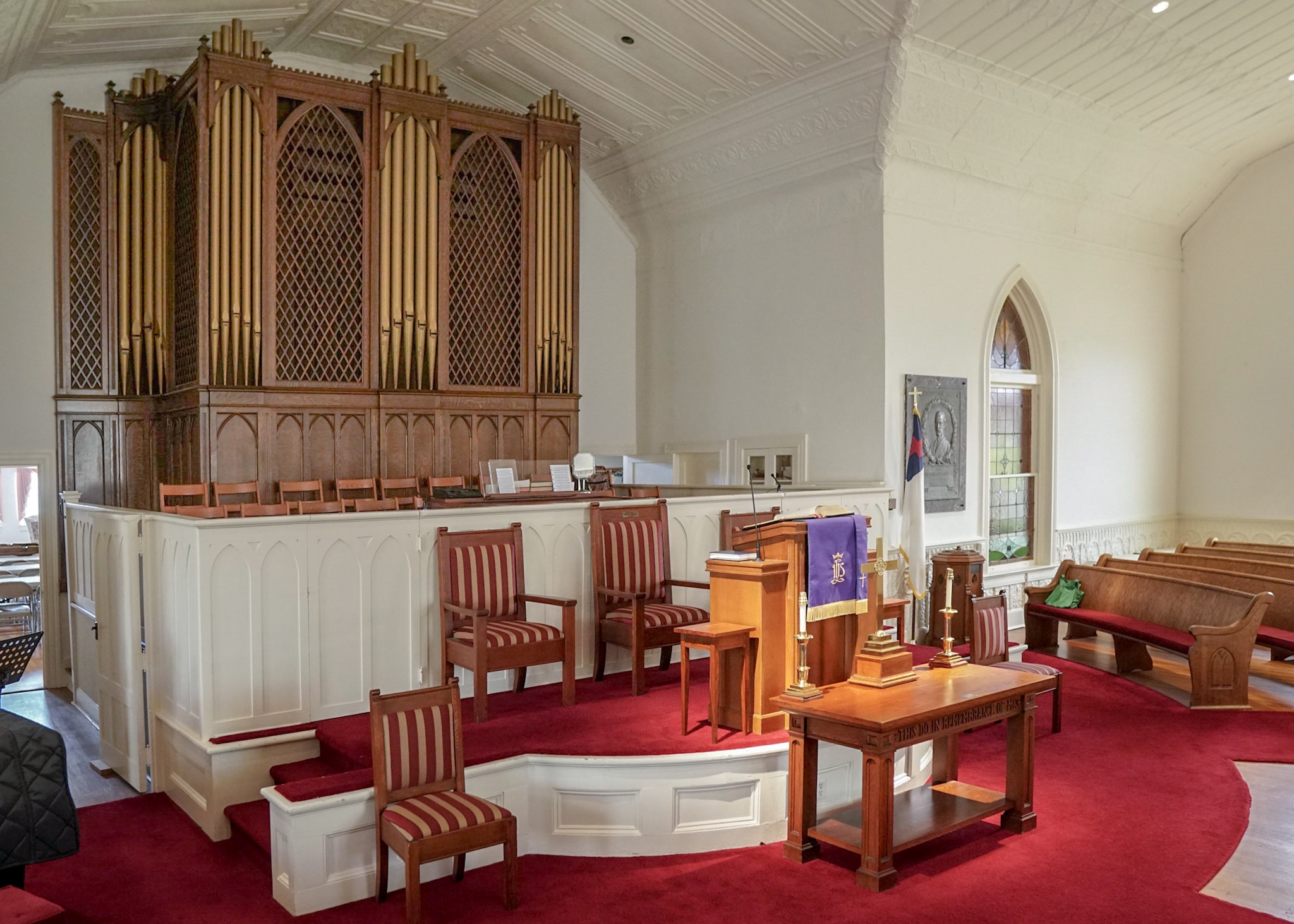
And a striking thing for me, even in the Presbyterian Church I’d been at previously—a big First Presbyterian Church, Bluefield, West Virginia; it’s not a small town, but a big city church with the big organ and choir and all the gizmos—what’s striking walking up to Hillcrest, and I was just there a few months back, is it’s a church without any glitz or glam or light shows or anything.
It’s a very ordinary church that, in your time there and before you and after you, is a church that’s committed to the ordinary means of grace, which was a very formative experience for me, being there for four years.
Irfon Hughes: Yeah, it was a simple church. And when I went there, of course, we didn’t have that big auditorium. And of course, they did so much building in my time. But it was small, and the auditorium, the old building, was really rough inside.
And it had a piano. A pretty jangly piano, which has long since died. But it was meant to be a home church.
Now, at Christmastime they still had Christmas trees inside and all the rest of it, and a Santa, I think. Certainly when I went there, I said, “This has to go.”
And the elders were in total agreement. And they said, “You’re right, it goes.” And it went.
They still put up some holly and stuff like that, but basically it was simple and everything.
I remember… oh, what’s her name? Rick Burkett’s mother-in-law. I was thinking about her yesterday.
Tim Hopper: Betty Kay Maher.
Irfon Hughes: Betty Kay. One Sunday we were so full that the deacons met with the elders straight after the service and cut a hole in the back of the building so people could sit in the old auditorium. And Betty Kay said to me as we were coming out, “We’d filled this church without a band.”
Tim Hopper: That’s right.
Irfon Hughes: And we put the piano at the back so that it never dominated the worship. And I still think that I would prefer the piano here, but I know that it can’t be done. But it was at the back, and the worship was focused on the word.
And we designed the seating… In the old church, there was a central aisle. And they asked me when they were putting up the new seating now, “What are we going to do about this?”
I said, “No central aisle.” “Well, how can we have weddings?” “Oh, simple,” I said. “People can walk down the front.”
And well, I think they still move the chairs out for a wedding so the bride can walk down the middle. But it was always that the central feature was the word. And that the focus was to be on the word.
It wasn’t to be to the side; it was to be the word. And that when you preach, you didn’t preach down the aisle, you preached to the people.
And Betty Kay said, “We did all this without a band.” That’s right. Just simple preaching.
And it was very simple because I’m a very simple man. And you came and I was beginning my exposition on Isaiah, I believe.
Tim Hopper: I was trying to remember if that started in the fall. It might have been in 2005, in my second semester, but that went almost my entire time at the college.
Irfon Hughes: And it was laborious because I’m not a Hebraist. And I was unaware of all the trends, redemptive-historical preaching, academic research. And I’m… that was never me. I did what I could and what I understood, and God was pleased to bless the work. I attributed all to God’s grace and glory. And the student fellowship sprang out of that.
Tim Hopper: And even during the regular worship at Shiloh—I’m sorry, at Hillcrest—towards the end of the time there, there were maybe a hundred or more students who would pack in the front sections and even around the sides of the pulpit.
Irfon Hughes: Right, there were chairs around there. And they’ve taken those away, I think, now. I don’t know. But students were right at the back.
I can remember the Sunday after 9/11. Well, they were packed all the way through.
But people used to say to me, “What are these streams of cars that go out of Grove City and all the way down Route 19? Where are they all going?” And of course, they would come to Hillcrest.
And streams of cars… I can’t understand why. I really, at this point in my life, have no idea why. I just thank God that it happened.
Tim Hopper: Now, you often undervalue your ministry there. But even just in my years there, knowing how many friends of mine sat under your ministry in a formative time in their lives…
certainly not all of them are in reformed churches anymore, but I think for many, many people, that really shaped their Christian commitments and, particularly as we’ve been discussing, a commitment to the word in a way that not all the churches in the area necessarily offered, which is a good thing in the Lord’s mercy.
Irfon Hughes: Yes, it was… it’s been amazing.
Tim Hopper: Was Isaiah your favorite book to preach through, or did you have a particular favorite ever?
Irfon Hughes: I never had a favorite book to preach through. The book I was preaching from was my favorite book. Sure.
Tim Hopper: Any books you didn’t preach through that you wish you had? Oh yes, yes, yes, yes. I wish I’d preached through Revelation, but I didn’t. I preached through it once, maybe, but never understood it.
I’m ashamed to say that I preached and I didn’t understand.
But since G. K. Beale had done that massive Commentary on Revelation, and then the digest commentary which I use frequently, and the book now, the sermons by Joel… Yeah, that’s… those three books are the two books.
I don’t have the big compendium of what he calls volume… G. K. Beale’s commentary book, but I use those other two, and I just wish I’d been able to preach through Revelation now.
But I can’t, and I never will, although I’m always hoping that some church is going to call me out of retirement and then I can do Revelation, but that’s not going to happen.
Tim Hopper: In 2007, you announced you were going to retire from Hillcrest, which was great timing for me because you retired, I think, about a month after I graduated from Hillcrest, so we got to finish our time together.
Our dear mutual friend Ryan Biese at our congregational meeting nominated me as one of the members of your retirement party planning committee, so I had that special privilege in my senior year of Grove City to plan your retirement.
Which at that point, neither of us could have ever imagined that you would then be my pastor again six years later in North Carolina.
But where did you go then from Hillcrest?
Irfon Hughes: Well, Katherine lived down here. Her husband is a lawyer, Kevin, and she had settled down here.
We had decided when we were going to retire, where would we go? And it was inevitable we would come down here to be close to Catrin.
My daughter Nicola, realizing that we would come down here, she and her husband uproots from Massachusetts and came down here as well.
So we had two daughters living down in this area, and it was inevitable that that’s why we would come.
And so Andy Webb in Fayetteville asked us if we would come and help him.
Tim Hopper: And he’s a PCA minister in Fayetteville?
Irfon Hughes: PCA minister in Fayetteville.
Tim Hopper: Who you knew through the Banner of Truth, is that right?
Irfon Hughes: I’d met him at Banner and then General Assembly, so we went to him. Within two months, Andy asked me if I would become the associate pastor.
I said no, because the church has to call you to be an associate. You can only be an assistant if you’re called by the session.
“All right,” he said, “we’ll call you to be an assistant.”
And I said, “No. Assistants can’t speak. That’s a Book of Church Order. Assistants only come when invited and can only speak when invited.”
Tim Hopper: For session meetings?
Irfon Hughes: At session meetings. And he said, “We’ll put a bylaw in to say you can speak at any time and you must come to every meeting.” And so, really, I became the associate pastor, and I preached. Regularly.
And by the time that end of our time—we were there for five and a half years—for the last year or 18 months, I preached there every Sunday evening, and he preached every Sunday morning.
And then I formed a friendship… I am gregarious, and I love meeting with other ministers, and I’d formed a friendship with Gabe Fluhrer, who was the minister here at Shiloh.
And Shiloh came into being in 2010, and they didn’t have a minister because, of course, they were just a church plant. And when they had difficult pastoral issues, Kevin was the only elder, and my daughter Catrin would… she’d ask me to do this, do that, and I dealt with several people, come up and spend a day here and do that.
Well, when Gabe came, I wasn’t necessary. I wasn’t needed.
But then in… when did I come here? 2014… about 2012, 2013, Gabe and I would have lunch together once every couple of months. And at the end of 2013, he decided he wanted an associate and put it to the session, and they interviewed me in The Pit. Do you know where The Pit is? It’s an eating house in town.
Tim Hopper: Oh, yes. A very good eating house.
Irfon Hughes: Yeah, so we ate at The Pit and they interviewed me and invited me to become the assistant. They put it to the church—I’d preached for Shiloh many times when it was on Penny Road—and there were no objections. And then I had to try the exams. Here I am, 72 years of age.
Tim Hopper: So we had tried to see if there was any way for you to serve out of bounds as a PCA minister, or maybe… I’m not sure, maybe our book of church order wouldn’t allow it, so you had to transfer your ordination.
Irfon Hughes: That’s right. Presbytery would not allow it. There was no reason why they wouldn’t allow it, but they decided that they wanted to be precise, and so I did the exams on the computer. And I passed those, and some were open book—they were the hardest ones. And then I was interviewed by Presbytery, and I came, and I was interviewed by Presbytery, and I was received.
Tim Hopper: Which was a very, very sweet interview. You were treated very respectfully, I—
Irfon Hughes: Oh, they did, did. And what is amusing, one of my references was Toby Curto—was Tony’s son—and they only read two of the references. Tony Curto gets up and says, “I want you to read all the references,” because of course his son’s name was on it.
Tim Hopper: So after 30 years of insisting you would never be an OPC man, at 72 you became an OPC minister.
Irfon Hughes: I became an OPC man. But I’ve never become a part of the OPC. I think that’s mainly because I’ve never gone to General Assembly. I was never invited to go. And whilst I agree with the delegated General Assembly—I agree with that, I think that’s very good—I’ve always felt a bit of a bump on a log for the OPC. I’ve been a pastor for them, and I will no doubt end my life as an OPC man.
Tim Hopper: So a year after you came here, Gabe Fluhrer left, so you were suddenly the solo pastor yet again, unexpectedly.
Irfon Hughes: Unexpectedly. I remember it very well. I’ll just say something. I was sitting in my house quietly, very quietly on a Wednesday, and the telephone goes and it’s Gabe. “Would you come for a session meeting this evening at 7:00?” I said, “Why?” “Oh, I’ve got to meet with the whole session.” Or did they come on their email? Maybe it came on an email.
Anyway, we were going out for supper with Gareth and Emily who had recently come to live close by, and I said I’ll come. And I can remember that drive. Traffic was horrendous, and I got into the church at twenty minutes to seven and they’re talking about mowing the grass.
And I thought, this is all I’ve come up for? I’m just going to be mad. And the people who mowed the grass at that time—were you a Deacon then?—the people who had mowed the grass had done so before 7:00 in the morning, and the people had complained because there’s an ordinance that you can’t start machinery before 7:00. So what are we going to do? We’re going to fire the grass mowers. And that’s what they did.
But I thought, this is mad. And then Gabe said, “This is the reason why I’ve invited you. I have been called and accepted the call to be an assistant pastor at First Pres, Jackson, Mississippi.”
Well, the other men were floored. I, strictly enough, I wasn’t floored. It doesn’t surprise me. I’m a minister. I know ministers get invited and they accept calls. I was a bit sad that he was going to go, but I wasn’t terribly shocked.
And so he told the congregation, and I picked up the pieces. I preached regularly, sometimes once a month, sometimes twice a month, and then going through the process of inviting a candidate.
Matthew came to preach in January of… …three years ago. Three years ago now. So where are we at? 2008… 2016? And he was invited to be the minister. And he came.
I had no hand in that. I didn’t even sit on the pulpit committee, so even though he was the son of a friend of mine, I had no hand in that. And I seek in every way I can to be his loyal supporter and friend, and that’s been true.
We are friends. I don’t always agree with him, but I think he’s a very brave and very faithful man. I believe he does what he thinks is best, and he’s faithful in doing it. I’ve got no complaints.
Tim Hopper: And so, for a time you served, you continued in your role as a pastor.
Irfon Hughes: I continued until 2017, when I felt that I’d been in the ministry 50 years. And I thought that it was an appropriate time to resign as the associate pastor—as the other pastor.
And I took up a role on the session until the session elected and ordained another Elder.
So I knew that once David Okken came on board, I would need to step down, and I decided to do it in December.
I didn’t want to come out in January or February when my hands are always cold, and so I stepped down December 31st, 2019.
And now I’m trying to enjoy retirement. Tim and I have been friends.
Tim Hopper: Almost 15 years.
Irfon Hughes: Almost 15 years. And Tim helped me move some of my books and help me pack book boxes when I left Hillcrest.
And he became a firm family friend and would help set up for the Fellowship on Sunday evenings, go down to our basement.
The church helped us buy some chairs, and he would go down, and there was a narrow little passage down. I was always dreading he’d hit his head on that low ceiling, but he did it faithfully.
Tim Hopper: For our College Fellowship group, we would hustle back to your house after evening worship and set up… I don’t know how many chairs we had, maybe…
Irfon Hughes: I think we had 20 chairs.
Tim Hopper: And then students would just sit all over the floor and…
Irfon Hughes: Oh yeah, all over.
Tim Hopper: Four rooms of your house with students in.
Irfon Hughes: Three rooms. All three rooms, and sometimes in the kitchen, but normally the three rooms. I would sit in the middle room, but the ones in the far right room… they were always dissolute students there. And I knew because I could see them, although they didn’t know I was watching.
And then in the other room it was what I call… and then Christmas time, we would have a Christmas party, and my wife had been given a set of false ears which illuminated.
And she would… a little battery, and she would say to students, “When you’re gone for Christmas, I’m going to have an operation on my ears.” And they’d go, “Why?” And she’d press this thing and they would illuminate. And that was always a laugh and a half.
And then we did several Banner books—and I think I introduced the students to the Banner as a publishing house. We did The Godly Man’s Picture.
Somebody in the north of England recommended that in the Banner conference, when asked what books have been really formative, and this young man, Malcolm McGregor, got up and said, “The Godly Man’s Picture,” and that persuaded me to read it. And it’s very good.
The one I really liked was Thomas Watson… Precious Remedies Against Satan’s Devices. I remember very well saying to the students, “Does anyone know Thomas Watson?”
And this young lady from Virginia—what is her name? Abby. Abby Barr said, “I know him.” She said, “He’s a friend of my pastor’s.” And I said, “How old is your pastor? Because he’s been dead since 1686.” And she said, “Oh!” But it always became “Abby’s pastor’s friend.”
Tim Hopper: She was one of the troublemakers who sat in the back room.
Irfon Hughes: That’s right, that’s right. She did.
Tim Hopper: I’ve never made this connection before, but I’m sure several marriages came out of College Fellowship. But interestingly, I first met my now brother-in-law at College Fellowship, Doug. He introduced himself to me in your hallway outside the kitchen, and then many years later introduced me to Maggie, my wife. So in some ways, my marriage is attributed to College Fellowship.
Irfon Hughes: Good. That’s right. That’s amazing.
Tim Hopper: Maybe as we conclude, could you read a little passage from The Godly Man’s Picture by Thomas Watson? This last paragraph on 125, on afflictions. It’s one I found that I had marked.
This is Tim’s testimony really, that he’s discovered, and I am glad to read it. Afflictions quicken our pace on the way to heaven.
It is with us as with children sent on an errand. If they meet with apples or flowers by the way, they linger and are in no hurry to get home. But if anything frightens them, they run, then they run with all the speed they can to their father’s house.
So in prosperity we gather the apples and flowers and do not give much thought to heaven. But if troubles begin to arise and the times grow frightful, then we make more haste to heaven and with David, run the way of God’s Commandments, Psalm 119:32.
What a profound insight that is from Thomas Watson. What a profound thought. When we don’t have troubles, then we tend to linger, but when we have afflictions, then we run to God.
What a good insight. I appreciate that very much.
I can only say that these books are worth getting, these Puritan paperbacks. I recommend them. [unclear] I recommend the Banner. And paperbacks.
And if you’ve got any doubts with regard to what it means to be a Christian, read Pink’s The Sovereignty of God.